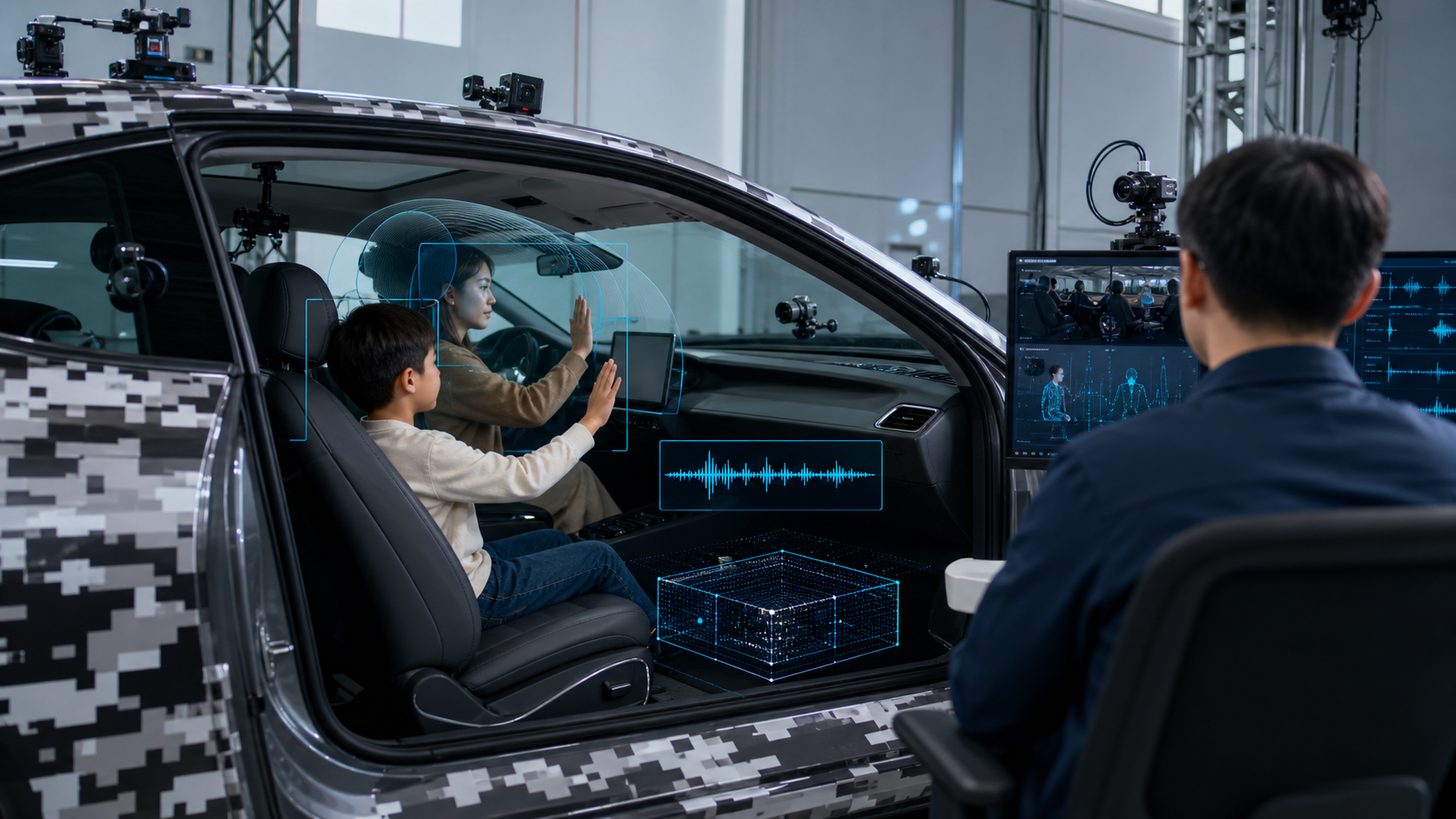
DataoceanAI helped a leading electric vehicle company build multimodal in-cabin datasets across diverse passenger profiles, sensor modes, interaction tasks, and vehicle scenarios—while keeping data quality, operational efficiency, confidentiality, and on-site safety under control.
Project Highlights
·Multimodal Coverage
RGB, infrared, video, audio, transcription, and participant metadata
·Diverse In-Cabin Scenarios
Adults, seniors, children, twins, pets, gestures, and human-object interactions
·Controlled Production
Integrated planning, quality assurance, confidentiality, and safety management
The Challenge
A leading electric vehicle company needed to continuously build visual, audio, and multimodal in-cabin datasets to support a range of intelligent cockpit applications.
The data would be used for vision-language models, identity recognition, occupant status monitoring, child and gesture interaction, pet and in-cabin object recognition, as well as multilingual and dialect speech interaction.
The complexity came from the diversity of the data itself.
Different projects involved different vehicle models, tasks, participant profiles, and acceptance criteria. Data collection needed to cover not only adults, seniors, and children, but also less common samples such as twins, child interaction scenarios, and pets. Tasks included daytime and nighttime RGB and infrared data, action videos, participant information, speech recordings, and transcription annotations.
At the same time, multiple vehicle models and tasks competed for vehicles, sites, equipment, and acceptance resources. A delay in one stage could affect the wider production schedule.
Some test vehicles had not yet been commercially released, introducing strict confidentiality requirements. Static collection required powered-on vehicles, while dynamic collection involved vehicles in motion, meaning that data quality, operational safety, and information security all had to be managed simultaneously.
The Solution
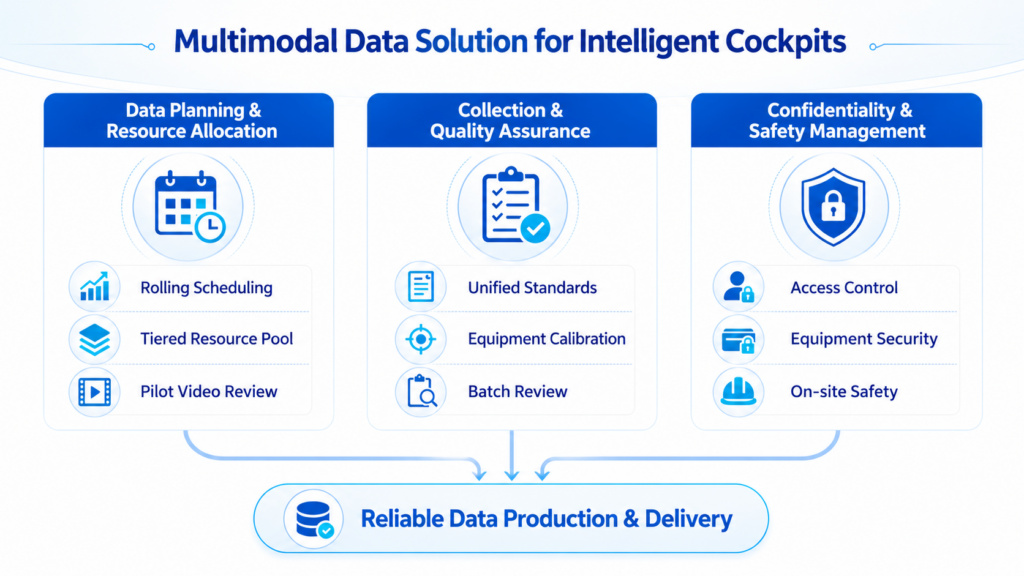
Data Planning and Flexible Resource Allocation
Before collection began, DataoceanAI translated dataset requirements into an executable production plan across four dimensions: participants, vehicles, equipment, and collection content.
Quotas were further broken down by participant group, vehicle model, time of day, scenario, and task type.
Based on available vehicles, workload, and acceptance capacity, the team established production and batch plans and adjusted priorities on a rolling basis. Participants were organized into resource pools covering adults, seniors, children, and special sample groups, with backup resources available when participant availability or sample ratios changed.
A pilot-video review mechanism was also introduced. Selected samples were submitted for early review so that action execution, shooting results, and data formats could be validated before larger batches moved forward, helping reduce the risk of large-scale rework.
A Closed-Loop Quality Workflow
Because tasks differed significantly in their standards and acceptance criteria, DataoceanAI established detailed collection guidelines and QA checklists covering action execution, scenario conditions, participant ratios, equipment checks, metadata, and file structures.
Collectors completed task-specific training and assessments before entering production.
During collection, the team checked camera status, equipment calibration, participant information, task execution, and data completeness. Each batch underwent internal review, with non-compliant data re-collected or corrected before final acceptance.
For tasks involving children and gestures, unified task IDs linked collection, annotation, and delivery to reduce data mismatches. Speech data was reviewed separately by language, dialect, and single- or multi-speaker scenario, including checks of audio, transcripts, and directory structure.
Confidentiality and On-Site Safety
For unreleased test vehicles, all participants completed confidentiality training and signed the required agreements before entering the site.
Access to sensitive areas was controlled and logged, personal electronic devices were restricted, and project equipment was centrally managed. Vehicles were inspected when entering, being used, and leaving the site to reduce the risk of exposing vehicle appearance, interior details, or test information.
Safety controls were also embedded directly into collection workflows. Static collection used braking, wheel restraints, key management, and on-site supervision, while dynamic collection included driver qualification, speed limits, and in-vehicle safety management.
The Results
By connecting data planning, resource allocation, collection, quality assurance, confidentiality, and safety within one production workflow, DataoceanAI established a more controlled approach to complex intelligent-cockpit data programs.
Layered participant pools and rolling scheduling helped maintain sample coverage across changing project requirements. Pilot reviews, batch-level QA, and re-collection mechanisms enabled issues to be identified earlier, while unified task IDs, directory structures, and acceptance criteria reduced mismatches between collection, annotation, and delivery.
For the customer, this created a consistent data foundation for ongoing in-cabin model development across multiple vehicle models, sensor configurations, participant groups, and interaction scenarios.
Build Intelligent Cockpit Models on Data Designed for Real-World Complexity
From data design and resource organization to on-site collection, annotation, quality assurance, and secure delivery, DataoceanAI provides end-to-end data engineering support for intelligent cockpit and multimodal AI development.
Talk to DataoceanAI about your next intelligent cockpit data project.